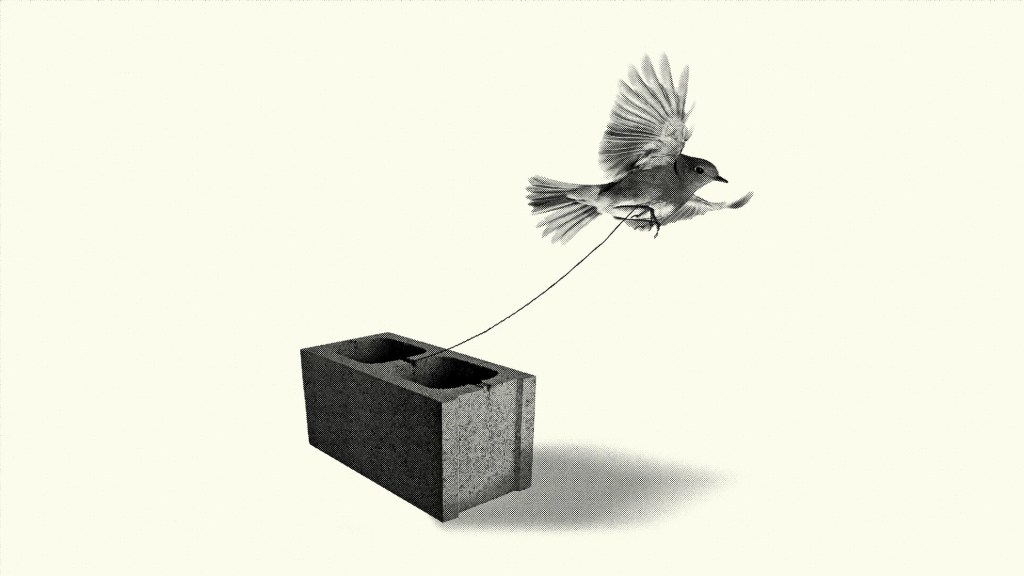
Growing up is often framed as a tidy, linear journey: childhood, adolescence, adulthood—click, click, click, like well-placed dominoes falling into their prescribed roles. Society doles out milestones like a checklist: get a job, find a partner, start a family, and maybe, if you’re really ambitious, grab yourself a houseplant you can (hopefully) keep alive longer than six months.
The narrative promises that at the end of this path, there’s a grand “arrival,” some shiny moment when you feel like you’ve finally made it. If you believe this, you’ll be waiting forever.
Adulthood, as sold to us, is one of the longest-running scams in human history. As far as I know, no one feels like they’ve “arrived.” Instead, we’re stumbling around like we’re trying to navigate a funhouse in the dark — occasionally bumping into what we thought adulthood looked like but, for the most part, trying to figure out where we went wrong.
The idea of adulthood as a structured, predictable path is a myth, a carefully curated illusion designed to make you feel like failure if you haven’t hit these arbitrary milestones by a certain age. The joke? None of it reflects the chaotic, beautiful mess that life actually is.
the Adulting Checklist
For many of us, “adulting” begins with the grunt work — paying bills, figuring out which insurance plan makes you least likely to drown in debt, and discovering the unspeakable joy of learning how taxes work (or don’t). Sure, these are the responsibilities society waves around like some weird badge of honour, but does waking up early and dragging yourself to a job you hate mean you’ve unlocked adulthood? Or does it just make you tired? These tasks don’t encapsulate the real weight of growing up, like how to balance our lives against the constant bombardment of everyone else’s expectations — our families, our friends, and society at large.
Take career success. We’re spoon-fed the idea that a career is the ultimate yardstick for adult credibility. Go to university, land a job, climb the corporate ladder, hit that mythical “I’ve made it” milestone, and boom — adulthood achieved. But for most of us, this trajectory is about as realistic as finding a unicorn.
Careers aren’t ladders; they’re poorly marked hiking trails where you’re equally likely to stumble into a dead-end as you are to find a clearing. Switch fields, take a gap year, or end up in a job you can’t stand — all the while society’s clock is ticking in the background, reminding you you’re “falling behind.” But who made that clock? And who says it matters?
The real problem isn’t that we fail to meet these expectations — it’s that we’re trained to believe our worth is tied to what we produce. It’s a productivity cult. We’ve been taught to think that logging 60 hours at a job that makes our soul shrivel is a sign of success. But does your LinkedIn title mean you’re actually thriving? Does checking off society’s boxes lead to happiness? Unsurprisingly, no.
Many of us hit those so-called milestones — high salary, stable job, respectable career — and realise we’re more burnt out than fulfilled. This idea that adulthood is synonymous with achievement is not just reductive, it’s dangerous. It’s a recipe for burnout and disillusionment, wrapped up in a shiny package labelled “success.”
And then, of course, there’s the relationship myth. Alongside career goals, romantic partnerships are another banner milestone society likes to wave in our faces. For women especially, the expectation is clear: you’re not really an adult until you’ve locked down a partner and started cranking out kids. But this fairy tale is not just outdated — it’s harmful. It pressures people into commitments they aren’t ready for and leaves them feeling like failures if they haven’t checked the relationship box by a certain deadline. And God forbid you decide not to want kids — you’re practically branded a traitor to adulthood.
But it’s not just gender. Class, race, geography — these all influence how we experience adulthood. A middle-class kid growing up in the suburbs may be able to follow the traditional path because they have the privilege of resources. But for someone from a low-income background, “adulthood” might mean working multiple jobs just to keep the lights on, not worrying about whether they’ve hit the marriage or mortgage milestone. The pressures are different, and pretending there’s one path to “adulthood” is as tone-deaf as it gets.
Still Not ‘There’ Yet? Join the Club
So, where does that leave us, the generation raised on these myths? Many of us spend our twenties (and thirties) grappling with the wreckage of these expectations. There’s this pervasive sense that by a certain age, we’re supposed to have our lives neatly sorted out. But if we’re being honest, none of us do. And that’s precisely where the myth of adulthood falls apart: No one, at any age, has it all figured out. This supposed roadmap to adulthood? It’s less of a blueprint and more of a haphazard doodle. And that’s okay.
Because here’s the real truth: There’s no singular way to “adult.” Life is messy. It doesn’t follow a script, and the more we try to force it into one, the more disillusioned we become. Being an adult isn’t about checking off boxes; it’s about learning to live with ambiguity. It’s about understanding that growth isn’t linear, success is relative, and nobody — no matter how put-together they seem — has all the answers.
In the end, adulthood isn’t some milestone-laden prize you unlock after completing the right number of societal quests. It’s about fumbling through the uncertainty, making mistakes, picking yourself up, and learning how to juggle the responsibilities society heaps on you with your own mental health and happiness. It’s about realising that nobody, not even your most polished LinkedIn connection, really knows what they’re doing all the time.
And maybe the most “adult” thing we can do is embrace the mess. Learn to live with the uncertainty and stop treating life like it’s a game of Monopoly where hitting every square is the point.
There’s no perfect version of adulthood. There’s just life—sprawling, unpredictable, sometimes frustrating, sometimes glorious life. And if we can learn to be okay with that? Well, maybe that’s the real secret to growing up.
 TO BE HONEST
Leave a comment