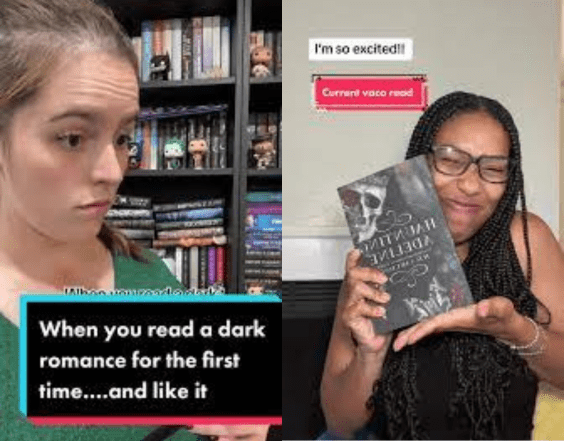
There’s a specific rush to reading dark romance — the genre that has flourished in the deep corners of TikTok’s BookTok community, thriving on stories of intense, obsessive love. You open these books, and suddenly you’re in a world where passion and danger intertwine.
The love stories are fiery and irresistible, but they’re also toxic, characterised by power imbalances, manipulation, and sometimes outright abuse. There’s an undeniable thrill in these narratives — but what is that thrill costing us, as readers and as a society?
The dark in dark romance
Dark romance, with its brooding, damaged anti-heroes and vulnerable heroines, often turns love into a battleground. These stories glamorise control, submission, and a kind of suffering that’s romanticised as “the price of real love.” It’s the fantasy of healing the broken man, of transforming cruelty into devotion, of taming the dangerous beast.
But beneath the surface of this genre lies a more troubling question: How is this reshaping what we accept as love?
In these novels, love doesn’t bloom gently — it’s forged through conflict and pain. The male protagonists wield their dominance like a weapon, and the women — while often painted as “strong” — are caught in a web of emotional or physical endurance. The more they suffer, the greater their love seems.
Haunting Adeline, one of the most popular dark romance novels in recent years, revolves around a woman stalked by a man who eventually becomes her lover. The stalking, rather than being framed as terrifying, becomes a form of passion. And for the reader, that narrative pulls you in. You might even find yourself rooting for the relationship, craving the intensity and forgetting the inherent danger. But when young women — many of whom are just forming their own perceptions of relationships — read these stories, I worry that they’re absorbing a harmful concept of love and relationships.
love vs power
It’s not hard to see how this genre taps into deeper, entrenched ideas about love and power. For centuries, women have been taught that love is something to be earned, that men’s anger or coldness is a sign of depth rather than a warning. Dark romance magnifies this idea, pushing it to its most extreme conclusion: that love can’t be real unless it’s hard and painful, that the mark of true intimacy is the ability to survive emotional and physical trials.
This dynamic extends beyond women. Men, too, are impacted by these narratives. Dark romance often celebrates the male character’s toxic behaviour as passion, reinforcing the idea that power, dominance, and emotional unavailability are inherently masculine traits. These novels suggest that a man’s brokenness is a sign of his complexity, not a reason for concern.
When readers — both men and women — consume these narratives, it normalises a model of love that is based on suffering and power, rather than mutual respect and emotional health. This feeds into a broader cultural conversation about what we accept as love.
Let’s be clear: Dark romance is seductive. The genre is addictive, partly because it taps into those forbidden or transgressive desires that so many of us repress. But the normalisation of toxic dynamics in these stories can be harmful.
Regular readers of dark romance, according to a 2022 study, are more likely to accept controlling or abusive behaviours in their real-life relationships. These stories blur the line between what’s thrilling on the page and what should never be acceptable in reality. And as we binge these novels, that line can start to disappear altogether.
art doesn’t exist in a vacuum
Publishers and editors of this genre is equally important, as they profit from the skyrocketing demand for dark romance, often green-lighting titles that push boundaries because they know there’s an eager audience. But what’s their responsibility in shaping the narratives we consume? Should they be more discerning about the kind of content they promote? Do editors have a duty to question whether these stories, while entertaining, are embedding harmful ideals about love and relationships?
It’s a delicate balance. On one hand, creative freedom is critical. Writers should be able to explore whatever themes they wish, even the darkest and most controversial. Fiction has always been a space for pushing boundaries, for imagining worlds where the rules of real life don’t apply. To censor or criticise writers for delving into taboo subjects could be seen as oppressive, limiting the scope of human imagination and artistic expression. After all, fiction doesn’t exist to moralise; it exists to make us think, feel, and question.
But on the other hand, when these stories repeatedly reinforce the same harmful dynamics—when dark romance becomes a genre where toxic love is not just a theme but the main attraction—we have to ask whether the narrative freedom granted to writers is truly liberating or if it’s perpetuating a more insidious cycle.
Writers may not intend to shape real-world perceptions, but art doesn’t exist in a vacuum. What we read influences how we think and what we accept. And that influence becomes especially potent when it’s packaged as romantic escapism, sold to an audience that’s largely made up of young, impressionable women.
what now?
Is it enough for publishers and editors to say, “Well, this is what readers want”? Or should they acknowledge their role in amplifying narratives that might have real-life consequences? The answer is complex, but it can’t be ignored.
Young women don’t have to stop reading dark romances, but they do need to engage deeper with these stories. It may offer an escape, a space to explore fantasies, but it also influence our perceptions of love and power.
Asking these questions will help: Why are these narratives so appealing? What dynamics is this story normalising, and how do they align with the values I want in real relationships?
Young women deserve the freedom to explore their desires, but it must be navigated thoughtfully, with a clear understanding of what makes a healthy relationship in real life.
This goes beyond personal awareness. Conversations about dark romance should happen in spaces where readers, especially younger ones, can reflect on the impact of these narratives. From TikTok to book clubs, fostering a culture of thoughtful discussion allows us to enjoy the intensity of these books without letting them shape our real-world expectations of love and intimacy.
Publishers and editors, too, hold responsibility. While creative freedom should be respected, they have the power to shape cultural conversations and create room for narratives that don’t just glorify toxic relationships but interrogate their effects. It’s not about policing content—it’s about encouraging deeper reflection on what we’re consuming.
The goal isn’t to take away anyone’s fantasies or to censor a genre. It’s about empowering readers to separate fiction from reality, to enjoy dark romance without losing sight of the fact that real love is based on respect, equality, and care — not power struggles and pain. What we read matters, because it subtly shapes how we view the world around us. By engaging critically with these stories, we can reclaim our understanding of love in a way that is healthy, balanced, and ultimately more fulfilling.
 TO BE HONEST
Leave a comment