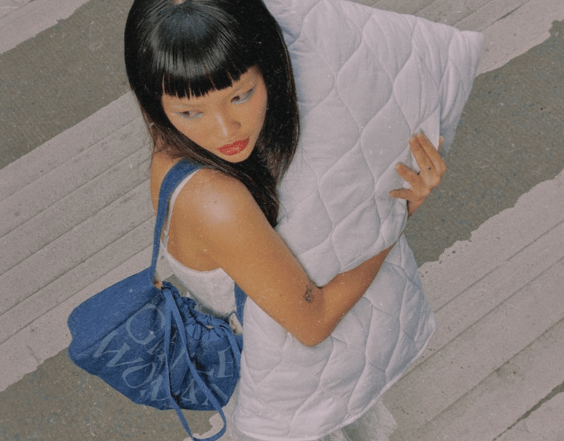
I was standing at a pelican crossing with my roommate when I spotted a woman carrying a Gentlewoman bag. Not the classic white tote, but a slightly different version — still unmistakable with its oversized logo sprawled across the front, or maybe the back. I could never tell.
“Do you like that?” I asked, motioning subtly in her direction.
My roommate scrunched her nose. “Not really. I’m not into mainstream trends.”
“Same!” I gasped, louder than I intended, feeling that rare rush of validation. There’s something deeply satisfying about finding someone who rejects the same thing you do, especially when that thing has infiltrated every space you inhabit.
trend or trap?
It’s not that I have anything against the Gentlewoman brand, specifically. But there’s something unsettling about how quickly a personal style choice can morph into a city-wide uniform.
Everywhere I turn, the Gentlewoman tote is there — on the train, in cafes, hanging off the shoulders of colleagues, students, even aunties doing their shopping. It no longer feels like an individual expression of taste, but a kind of cultural script everyone’s reading from.
It’s the same feeling I had when I first noticed the global obsession with Adidas Sambas. What began as a niche revival, fuelled by influencers and celebrities like Bella Hadid, quickly became inescapable. Not long after, Puma released the Palermo, its own version, slipping into the market just in time to capture that same wave of interest.
There’s a rhythm to these things — an item gains traction, it floods the streets, and just as it reaches saturation, it begins to feel almost obligatory. No longer a choice, but an inevitability.
Whether it’s the local Gentlewoman tote or the global Samba, the psychology behind these trends feels strangely identical: we’re constantly balancing our desire to belong with our need to stand out.
But here’s the tipping point. What once felt unique now feels oppressive. It’s hard to separate the product from the noise around it, and harder still to ignore how we’re all swept up in it.
It’s not just the bags we carry or the shoes we wear — it’s the stories these items reflect about who we are, or who we’re trying to become. And they’re spun so quickly now, accelerated by social media and influencer culture, that there’s hardly time to pause before the next thing arrives.
from must-have to meh
Take the resurgence of Dior’s Saddle Bag, for example. It was everywhere in the early 2000s, became a forgotten relic, and now, thanks to its reintroduction by influencers and celebrities, it’s back — this time with a price tag that borders on unattainable.
Bottega Veneta’s Mini Jodie, another high-end accessory, has similarly risen to iconic status, thanks to its positioning on the arms of A-listers. The price points for these bags — up to $6,400 for a Dior Saddle Bag, and $26,000 for the Bottega — create the illusion of exclusivity.
But it doesn’t take long for fast fashion brands like Zara and Mango to replicate these designs, bringing them to the masses. Before you know it, what was once luxury becomes familiar, replicated, and consumed en masse. And as the market gets saturated, the allure fades.
This is where fast fashion feeds into our habits. We start by dreaming of that Dior Saddle Bag, but end up settling for a Zara imitation that feels good for a moment — until the next trend inevitably rolls in. The problem with this is not that you’re wearing a knock-off; it’s that these cycles of consumption are driven by our constant craving for what’s new. And we buy into it, quite literally.
The items we buy, wear for a season, then discard, all contribute to an industry that’s responsible for an estimated 10% of global carbon emissions. In Singapore alone, where fashion is often imported and consumed at breakneck speed, the National Environment Agency reports that 168,000 tonnes of textile waste are discarded annually.
The bags we carry today — whether they’re from Zara or Gentlewoman — may end up as tomorrow’s landfill.
This is where luxury fashion, ironically, becomes part of the solution. Because of their high price tags, buying luxury items encourages mindful consumption.
When you’re looking at an investment of $5,000 for a bag — or God forbid, $30,000, you don’t buy on impulse. You research. You think about it. You weigh whether it’s something that fits your style long-term.
It’s a pause that’s missing from the fast fashion frenzy, where the temptation to buy often overrides any thought about durability or need. The Gentlewoman tote, like so many other fast fashion items, feels like an easy, low-cost choice.
But in the long run, these “low-risk” purchases add up — both in terms of cost and environmental impact. The more we buy, the more we end up discarding. And all the while, the system of mass consumption keeps turning.
Luxury, for all its exclusivity, can promote a slower, more deliberate form of shopping — choosing quality over quantity.
Wear It, Share It
This mindset of mindful consumption can be applied at any price point, whether you’re considering a designer piece or a fast fashion purchase. For those looking for more sustainable alternatives, Singapore offers many options.
Rather than buying into the latest fast fashion craze, The Fashion Pulpit promotes clothing swaps, allowing people to exchange items they no longer need for something new to them, without the waste.
Similarly, stores like Refash have tapped into the growing demand for second-hand fashion, offering a way to refresh our wardrobes sustainably. There’s also Swapaholic, which organises clothing swap events that help reduce fashion waste while encouraging conscious consumption.
These brands represent a shift towards slow fashion in Singapore — a movement that values quality, sustainability, and individuality over chasing fleeting trends.
Thrifting and clothing swaps are not only environmentally responsible, but they also offer a chance to curate a wardrobe that feels personal and resists the endless churn of fast fashion.
Loving fashion and enjoying shopping doesn’t mean you can’t be a conscious consumer. Whether it’s a Gentlewoman tote or the latest pair of Adidas Sambas, we need to be more thoughtful about where we spend our money.
When we buy something, we’re endorsing the system that created it — fast fashion or slow, quality-driven craftsmanship — whether we intend to or not. The cost isn’t just about what’s in our wallet; it’s about the lasting impact our choices have on the environment and the future of fashion.
Trends like the Gentlewoman tote will always flood our streets, but the real value of what we wear goes beyond fleeting popularity. The pieces we invest in should reflect more than just keeping up — they should reflect a commitment to style, sustainability, and choices that outlast the current ‘It’ item.
 TO BE HONEST
Leave a comment