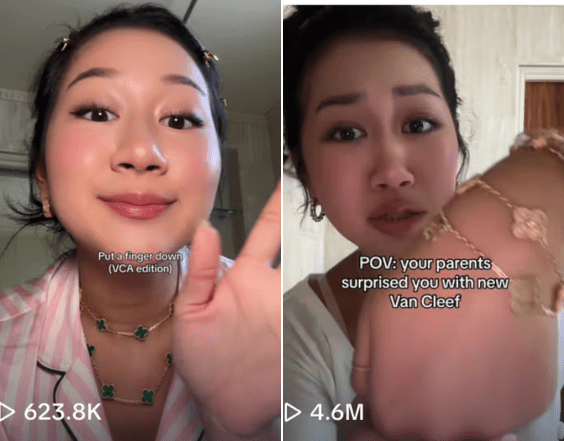
There’s a certain kind of TikTok video that stops you mid-scroll: an effortless parade of luxury so detached from your reality that it feels like another world. That’s exactly how I felt the first time I watched @chloeabeth4545’s “stay-at-home daughter” and “rich girl” content.
The title alone had me rolling my eyes: a day filled with pampering and “errands” at high-end boutiques, followed by exclusive events, all documented as if this was a typical Tuesday. As I stood at a bus stop after a draining workday, debating whether I had enough groceries to scrape together dinner, I was immediately turned off. The sheer privilege on display felt tone-deaf, especially when framed as “just another busy day.”
But I kept watching — and finally got the joke. It was all satire. The perfectly framed shots of luxury, the nonchalant tone as she flitted from one indulgence to the next was a performance. She wasn’t flaunting her wealth without a second thought; she was making fun of herself, of the ridiculousness of this rich girl persona. What I had initially written off as an obnoxious display of privilege, I realised, was clever, sharp self-parody.
rich girl fantasy
Still, there’s something irresistible about watching her exaggerated life — ironic or not — that kept me hooked. It’s like watching a reality show where the stakes are so low, you can’t help but feel a strange sense of comfort. This is part of the draw; there’s something soothing about sinking into a fantasy of unattainable wealth, even when you know it’s out of reach. Even when you know it’s a joke.
And that’s where the real complication comes in: satire, especially on a platform like TikTok, doesn’t always translate. The lines between parody and reality blur quickly, and many viewers might miss the joke entirely. Satire like Chloe’s can easily backfire when it’s consumed alongside content that is meant to be aspirational. For some, her exaggerated portrayal of privilege might be taken at face value, reinforcing the very dynamics she’s making fun of. On TikTok, where curated luxury is everywhere, it’s easy to lose sight of the fact that these lives aren’t attainable for most people.
It’s the same pull that has me glued to influencers who walk around their LA mansions casually in their daily vlogs, wearing designer handbags, and living lives of perpetual leisure. Sure, it’s not real for me, but for those few moments, it feels like it could be.
wealth = success?
That’s where the danger lies. This kind of constant exposure to luxury, even when it’s exaggerated or satirical, conditions us to see wealth as the ultimate marker of success. Over time, we begin to normalise this as the standard we should aspire to, whether or not we understand it’s a joke.
This dynamic is exacerbated by platforms like TikTok, whose algorithms are designed to feed our desires and show us more of what makes us stop and watch. Every time I linger on a video like Chloe’s, TikTok takes note and gives me more — more lavish lives, more opulent backdrops, more curated excess. Whether it’s parody or not, the algorithm can’t tell the difference.
Historically, wealth has always been a marker of status and power, but platforms like TikTok have transformed it into something more distorted. The accessibility of these videos, the way they make luxury seem both aspirational and within reach, distorts our understanding of what’s actually possible. It’s a reinforcement of long-held ideals about wealth equating to worth — a legacy rooted in capitalist systems that promise upward mobility but rarely deliver it.
We’re seduced by the idea that if we just work hard enough, or spend wisely, or get lucky, we might get there too. It’s a seductive lie, but a lie nonetheless.
the other end of the spectrum
On the flipside, it’s exactly these videos that are revealing the cracks in our capitalist consumer culture. By constantly feeding us images of unattainable wealth, social media both perpetuates and exposes the inherent inequalities in the system. We watch, we consume, we aspire, but we never quite arrive. And that’s the point. The system thrives on our desire for more, even as it keeps us from ever truly achieving it.
The viral story of Zoe Gabriel, the teen who called Charles & Keith a “luxury” brand, offers a poignant counterpoint. Zoe’s joy came not from an indulgence but from a gift — her father had bought her the bag, and to her, it was a symbol of love and generosity. The handbag wasn’t about flaunting wealth; it was a precious, meaningful present.
Her story resonated because it was deeply relatable — she represented the experience of most people, for whom a hundred-dollar handbag truly is a luxury. It sparked a viral conversation because it revealed just how wide the gap between aspiration and reality has become.
What’s interesting is that both ends of this spectrum — the hyper-wealthy and the “luxury” of a mid-range bag — exist within the same media ecosystem. They both serve to remind us of how unattainable true wealth is, and yet we keep watching, keep aspiring.
guilty pleasure
Even when we recognise the absurdity or satire in content like Chloe’s, we can’t stop consuming it. We’re drawn to it, not only because it entertains but because it taps into deeper frustrations we have with our own limitations.
We know the lives we’re watching are unattainable, yet we can’t help but desire some part of them, even if it’s just through a screen. This is the real power of platforms like TikTok: they offer us a front-row seat to a theatre of wealth, a spectacle that constantly reminds us of what we don’t have, but might one day obtain.
Chloe’s satire works because it exposes the ridiculousness of it all — the absurdity of a life so out of reach for most of us that it can only be funny. But even as we laugh, we’re still drawn in. We’re still watching, still playing along, even when we know the game is rigged.
And maybe that’s the real joke. We’re laughing, but we’re still complicit in the fantasy.
 TO BE HONEST
Leave a comment